

Key Takeaways:
Your property tax assessment ratio is the percentage of your home's market value your county actually taxes you on — and in 2026 that percentage swings from 40% in Georgia to 100% in Texas, California, Florida, and Maryland, with New Jersey pinning down no fixed number at all.
TL;DR
- The property tax assessment ratio by state ranges from Georgia's 40% to 100% in Texas, California, Florida, and Maryland in 2026.
- New Jersey sets no single ratio — each municipality gets its own Director's Ratio, reset annually under Chapter 123.
- Maryland reassesses only a third of the state each year, so your ratio only moves on your county's three-year cycle.
- TaxDrop runs protests and appeals across all six states, matching each state's ratio rules to build your case.
Why this matters
The assessment ratio is the math your county uses to turn your home's value into a tax bill. If your state's ratio is 100%, your assessed value should track close to what your home would sell for today.
If the ratio is 40%, like Georgia, your assessed value should land at 40 cents on every dollar of fair market value — not more.
An estimated 30-60% of properties nationwide are over-assessed relative to their state's own ratio. Most owners never check the math. The average property tax rate by state guide covers the rate side of the bill; this page covers the ratio that rate gets applied to, and the two get confused constantly.
Property tax assessment ratio by state: the 2026 numbers
Most states, including four of the six TaxDrop operates in, assess property at 100% of market value. Georgia is the clear outlier at 40%. New Jersey doesn't publish a single statewide figure at all — it runs on municipal ratios that reset every year.
The 2026 assessment ratio table
National norm (most states)
- Statutory assessment ratio: 100%
- Basis: Market value assessment — the standard the majority of US states use
Texas
- Statutory assessment ratio: 100%
- Basis: Market value, per Texas Tax Code § 23.01
California
- Statutory assessment ratio: 100% of capped base year value
- Basis: Proposition 13 base year value, capped at 2% growth per year
Florida
- Statutory assessment ratio: 100% of "just value"
- Basis: Just value equals market value; homestead increases are capped separately
Maryland
- Statutory assessment ratio: 100% of full cash value
- Basis: Phased in over a three-year reassessment cycle
Georgia
- Statutory assessment ratio: 40%
- Basis: Fair market value, per O.C.G.A. § 48-5-7
New Jersey
- Statutory assessment ratio: No fixed ratio
- Basis: Set annually per municipality (Director's Ratio, Chapter 123)
Five of the six states TaxDrop serves land at a 100% ratio — Texas, California, Florida, Maryland, and the national norm most other states follow. Georgia trails every other state on this list at 40%, the only fractional ratio in the group. New Jersey sits outside the table entirely: its ratio isn't a number you can look up once, it's recalculated every year, municipality by municipality.
The methodology behind this table is state statute, not a survey — Texas Tax Code § 23.01, California's Article XIII A (Prop 13), Florida's Constitution Article VII, Maryland's Tax-Property Code, and Georgia's O.C.G.A. § 48-5-7 all set these numbers by law, not by local custom. The one thing this table can't tell you: New Jersey's actual ratio for your specific town this year, because that number is set by the county tax board annually and isn't fixed in statute the way the other five states' ratios are.
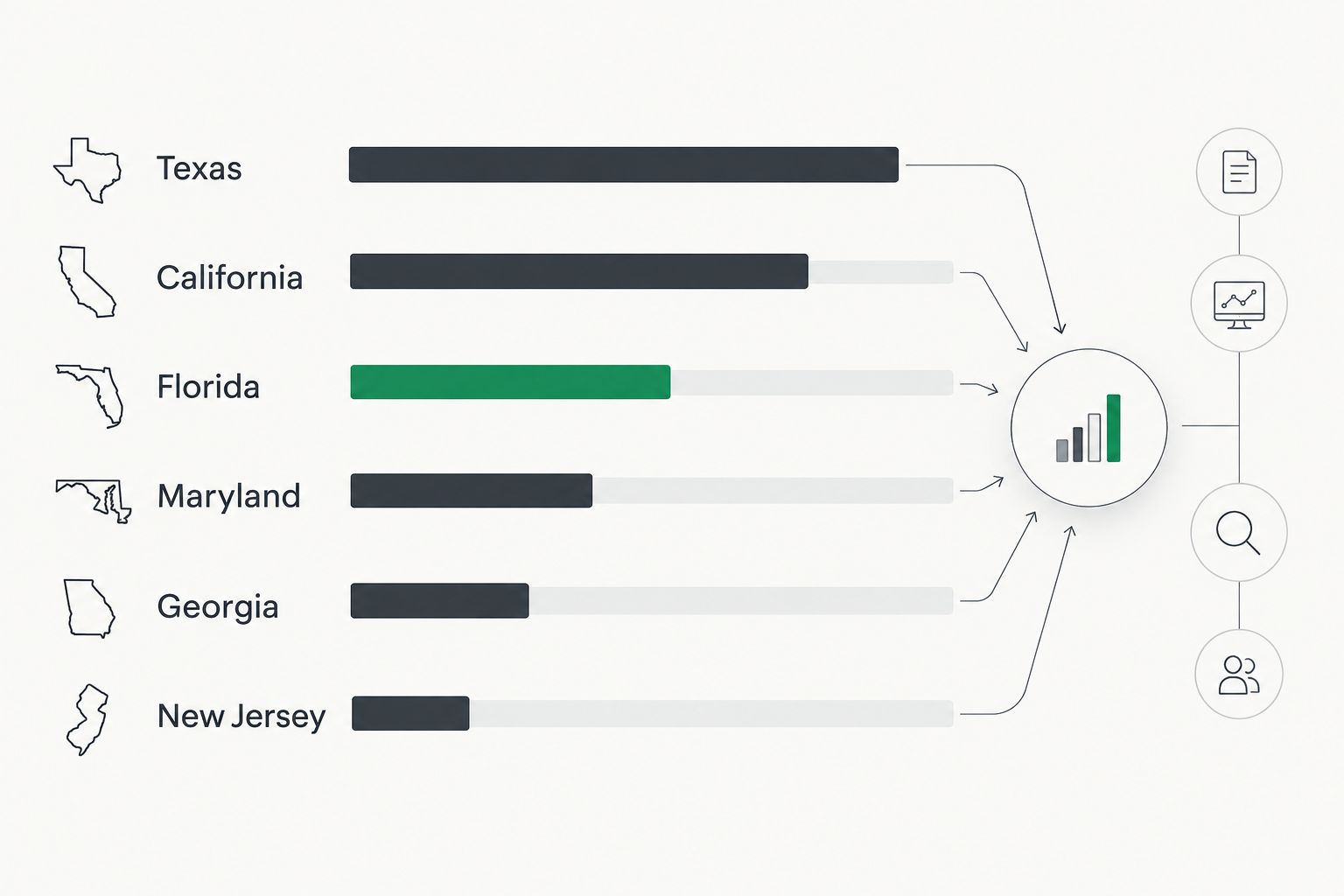
Georgia sits well below the other five states, all of which assess near full market value.
How to use these benchmarks
- Georgia owners: if your notice shows an assessed value above 40% of what recent sales say your home is worth, that's a documented overassessment — file an appeal with the Board of Tax Assessors.
- Texas, California, Florida, and Maryland owners: your assessed value should sit close to 100% of current market value, subject to your state's own caps (Prop 13 in California, Save Our Homes in Florida). Pull recent comparable sales before you assume the number is right.
- New Jersey owners: check your municipality's Director's Ratio before filing anything. Filing when you're already below the common level range can raise your assessment under Chapter 123 — this is the one state on this list where a generic appeal is a real risk, not just a wasted trip.
- Maryland owners: the state reassesses only a third of its properties each year, so confirm your group is in this year's cycle before you count on a live appeal window.
A free assessment check on TaxDrop takes under two minutes and tells you where your number sits against your state's ratio before you file anything.
California's Prop 13 cap and Florida's Save Our Homes cap both work off a base-year value rather than current sales price, which is why a long-time homeowner's assessed value can sit well under 100% of today's market value even in a 100%-ratio state. The homestead exemption to bigger property tax appeal guide walks through how that cap interacts with your homestead status.
Check your assessment ratio
Free instant analysis compares your notice to your state's ratio.
FAQ
What is a property tax assessment ratio?
It's the percentage of a property's market value that a county actually taxes. Texas, California, Florida, and Maryland use 100% ratios in 2026; Georgia uses 40%.
What state has the lowest property tax assessment ratio?
Georgia, at 40% of fair market value under O.C.G.A. § 48-5-7. It's the only fractional ratio among the six states TaxDrop serves.
Does California assess property at 100% of market value?
Yes, but the base is capped under Proposition 13, not current market price. A home is assessed at 100% of its capped base year value, which can sit well below today's sale price.
Why does Georgia use a 40% assessment ratio?
State law sets it that way under O.C.G.A. § 48-5-7. A $400,000 home should carry an assessed value near $160,000, not higher.
What is New Jersey's assessment ratio?
There isn't one fixed statewide number. Each municipality gets its own Director's Ratio, reset annually, and Chapter 123 sets the common level range used to judge appeals.
How is Maryland's assessment ratio calculated?
Maryland assesses at 100% of full cash value, but phases the change in over a three-year reassessment cycle covering one third of the state each year.
Can a wrong assessment ratio be appealed?
Yes. If your assessed value doesn't match your state's ratio against current market evidence, that's the basis for a protest in Texas or an appeal in California, Georgia, Florida, New Jersey, or Maryland.
Is Texas's assessment ratio 100%?
Yes, under Texas Tax Code § 23.01 property is appraised at 100% of market value each year, with no fractional assessment.
One last thing
New Jersey is the one state on this list where checking your ratio matters more than filing fast. Comparable assessments aren't even admissible there — only sales evidence counts — and filing below the common level range can move your number up instead of down. Every other state on this table rewards a quick check; New Jersey rewards a careful one.
Related guides
Paying Too Much in Property Taxes?
Let our licensed property tax experts assess your tax bill for potential savings. Over 80% of protests get a reduction of more than $1,000 and it takes less than 3 minutes to enroll.
⏰
🏠
💵
No Savings No Fee