

Key Takeaways:
Hiring someone to appeal your property taxes is worth it when your assessment looks too high and you lack the time or evidence to make the case yourself. If you have clear comparable sales and time before the deadline, filing yourself is a reasonable choice. In New Jersey, check before filing: an appeal can raise your assessment, and the state charges a nonrefundable filing fee.
TL;DR
- Is it worth hiring someone to appeal your property taxes? Yes, when evidence is complex or your time is limited.
- TaxDrop full-service representation is best for eligible Texas owners who want a consultant to handle the protest.
- TaxDrop One is best for eligible owners who want an appeal packet but will file it themselves.
- New Jersey owners must check the Chapter 123 ratio test before filing; an appeal can raise their assessment.
Is it worth hiring someone to appeal your property taxes?
Yes, if the help removes work you cannot do well before your deadline. Compare the work you would still need to do under each option, not just the fee. These are the practical choices for an owner reviewing a 2026 assessment notice:
File yourself
- Best for: An owner with clear sales evidence and time to prepare it
- What you gain: Control over the case and no service fee
- What you still need to consider: You must check the rules, gather evidence and file on time; New Jersey charges a filing fee
Self-serve appeal packet
- Best for: An owner who wants prepared evidence but will handle submission
- What you gain: A more organized case without full representation
- What you still need to consider: You pay the packet fee regardless of the result and remain responsible for filing
Full-service representation
- Best for: An eligible Texas owner who wants a consultant to handle the protest
- What you gain: Someone else prepares and handles the case
- What you still need to consider: Coverage is limited, and a successful reduction triggers a service fee
TaxDrop offers both full-service property tax protests in eligible Texas counties and a self-serve appeal packet in its covered areas. The distinction matters: a packet does not mean someone will attend a hearing for you. Full-service does not extend across every state where the packet is available.
Why this matters
Your property tax bill depends in part on your assessment: the value the assessing office assigns to your property. If that value is too high, an appeal gives you a way to challenge it with evidence. A lower assessment does not automatically mean the same-sized drop in your tax bill; tax rates and applicable exemptions also affect what you owe.
TaxDrop's stated figures put over-assessment at 30–60% of properties, while about 5% of owners appeal. Those figures are a reason to check your notice, not proof that your property is over-assessed. Your decision rests on your property's evidence, the filing rules and the time left in your 2026 window.
Hiring help changes who does the work. It does not replace the need for a sound case. If recent comparable sales support the county's value, paying someone to submit the same weak argument is not the next move.
When full-service representation earns its fee
Full-service is best for an eligible Texas owner who cannot spend time building a case or handling a hearing. TaxDrop's property tax protest service uses licensed-consultant-led representation in 17 Texas counties. Its service fee applies only when it wins an assessment reduction; the fee is based on the reduction in assessed value, not on the tax dollars saved.
That distinction is important when you compare providers. An assessment reduction and an annual tax saving are different figures. Ask what the fee is calculated from, who submits the evidence and who appears at a hearing before authorizing any company to act for you.
Texas owners should also check the date on their Notice of Appraised Value. The stated Texas protest deadline is May 15. If your 2026 deadline is close, a service is worthwhile only if it can take the case within the remaining filing window. For more detail on what fees mean in this state, see the Texas property tax appeal cost guide.
TaxDrop full-service representation is best for an eligible Texas owner who wants the protest handled; its limit is its 17-county service area. Outside that area, compare filing yourself with the self-serve option rather than assuming a consultant can represent you.
When a self-serve packet makes more sense
A packet suits an owner who can submit an appeal but does not want to assemble the supporting case from scratch. TaxDrop One, TaxDrop's property tax appeal packet, offers a free instant analysis first. The stated savings estimate takes under 2 minutes. If you choose the packet, you pay a flat fee per property and tax year whether or not the appeal succeeds.
The packet's coverage is wider than full-service coverage: 43 Texas counties, 6 California counties, 4 Georgia counties, and statewide availability in Florida, New Jersey and Maryland. Availability alone does not mean filing is a good idea. You still need to check your evidence and follow the rules of the office that receives your appeal.
TaxDrop One is best for an eligible owner who wants prepared appeal materials but is ready to file; its drawback is that the packet fee is due regardless of the outcome. If you want someone to take over the filing or hearing, do not mistake the packet for full-service representation.
When to file yourself
File yourself if you can identify relevant closed sales, explain why they support a lower value and meet your deadline. A clear error in the property record also gives you a specific point to raise. You retain control of the filing, but you take responsibility for checking which evidence your state accepts.
Do not assume the same argument works everywhere. Texas and Georgia permit an unequal-appraisal or equity argument based on how comparable properties were assessed. That argument does not apply in California, Florida, New Jersey or Maryland. In New Jersey, comparable assessments are inadmissible; use sales evidence instead.
DIY is best for an owner with a straightforward case and enough time to check the filing rules. Its drawback is that a missed deadline or an unsupported argument is yours to fix, if the process still allows it.
Check your case before you choose a service
A service decision is easier once you know what the dispute actually is. Work through these steps using your 2026 notice and your property's records:
- Read your notice. Find the assessed value, the property details and the office responsible for the value. Check that the description of your property is accurate.
- Check recent sales. Look for closed sales of comparable properties. Note meaningful differences before treating another sale price as evidence for your own home.
- Choose your path. Decide whether you can prepare and file the case yourself, want a packet, or qualify for full-service help in Texas.
- File on time. Confirm the deadline and filing instructions for your specific office. Buying a packet or hiring help does not erase a filing cutoff.
These steps separate a potentially high assessment from a case you can support. They also keep you from paying for help before checking whether the notice gives you an issue to challenge.
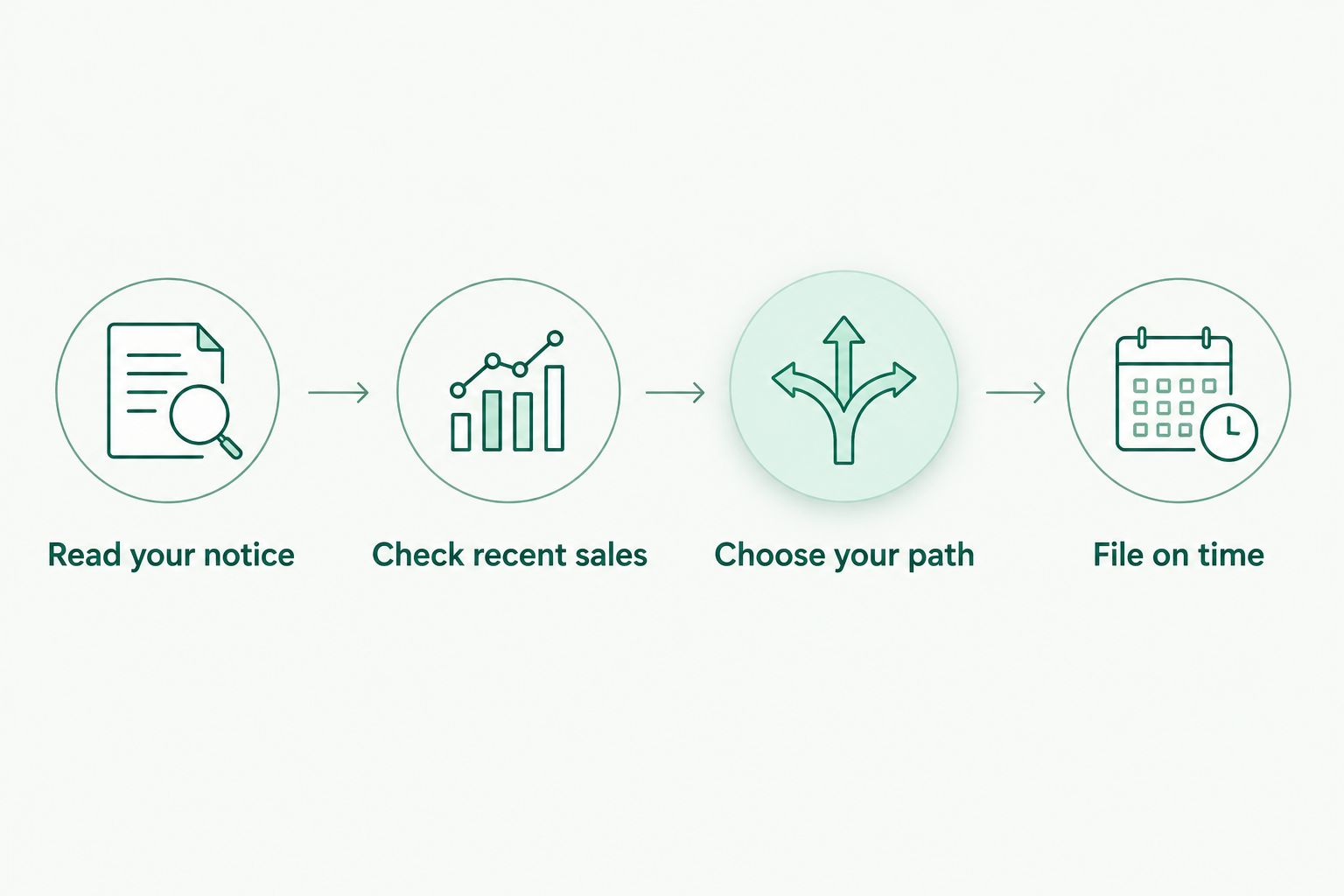
Check the evidence and deadline before deciding how much help you need.
Why hiring help varies in value
There is no single answer for every property. These factors determine whether the work you hand off is worth paying for:
- Evidence quality. A packet or consultant can organize a case, but neither can turn unrelated sales into strong comparisons. Check how the selected sales relate to your property.
- Time before the deadline. A clear case is still unusable if it is filed late. Start with the date on your notice rather than the date you receive a reminder.
- Who will submit the appeal. Full-service representation and a self-serve packet solve different problems. Confirm which tasks remain yours.
- County coverage. TaxDrop's Texas full-service area is narrower than its packet coverage. Check eligibility before comparing the two as though both are available.
- Property count. A landlord with several notices has more deadlines and evidence sets to manage than an owner with one home. Compare help against the work for each property.
- State-specific filing risk. In New Jersey, an unsuccessful appeal is not the only concern: the assessment can increase under the Chapter 123 ratio test.
For a landlord, the appeal is also separate from the records used to run the property. Reviewing tax software for real estate investors addresses the bookkeeping side; it does not establish whether a county's assessed value is wrong. Keep the appeal evidence tied to each property's notice and relevant sales.
How the answer changes by state
Texas: The process is called a protest, filed with the Appraisal District, or CAD, after a Notice of Appraised Value. TaxDrop offers both full-service representation in 17 counties and TaxDrop One packets in 43 counties. Its stated informal success rate in Texas is 80–90%; that is not a promise about your case. Check the May 15 deadline on your 2026 notice.
California: The process is an appeal involving the Assessor's Office and an Assessment Notice. Deadlines vary by county. TaxDrop One covers 6 California counties; Texas full-service representation does not apply. Verify the county-specific filing window before paying for a packet.
Georgia: An appeal follows the Annual Notice of Assessment from the Board of Tax Assessors. The stated filing window is approximately 45 days from the notice. Georgia allows an equity argument, but you still need evidence that fits your property. TaxDrop One covers 4 Georgia counties.
Florida: Review the TRIM notice from the Property Appraiser. An appeal or petition is heard by the Value Adjustment Board, and the stated window is approximately 25 days from the TRIM notice. TaxDrop One is available statewide; full-service representation is not.
New Jersey: The municipal Assessor sets the value, and the County Board of Taxation hears the appeal. April 1 is the general deadline, but Burlington, Gloucester and Monmouth use January 15. Filing can raise an assessment under the Chapter 123 ratio test, and New Jersey charges a nonrefundable filing fee. Check that test before treating any packet as a reason to file.
Maryland: SDAT, the State Department of Assessments and Taxation, handles assessments; there is no county appraisal district. A reassessment notice generally starts an approximately 45-day appeal window, while January 1 applies to an off-cycle appeal. Maryland reassesses one third of the state each year, so not every owner has a live reassessment window in 2026. TaxDrop One is available statewide.
Related questions
Is hiring someone better than filing a simple appeal myself?
Not necessarily. File a simple, well-supported appeal yourself if you can meet the rules and deadline. Hire help when preparing the evidence or handling the process is the obstacle, and confirm exactly which work the service takes on.
Does a successful assessment appeal guarantee a smaller tax bill?
No. A successful appeal lowers the disputed assessment, but your final bill also depends on tax rates and any applicable exemptions. Keep the assessment reduction separate from the tax saving when judging a service fee.
Can a property tax appeal raise my assessment?
Yes, in New Jersey. The County Board of Taxation applies the Chapter 123 ratio test, and an assessment below the common level range can be increased. Do not file there based only on a neighboring property's assessment; comparable assessments are inadmissible.
FAQ
Is it worth hiring someone to appeal your property taxes in 2026?
Yes, when you have a supportable case but lack the time to prepare or handle it. If the case is simple and you can meet the deadline, filing yourself is a reasonable alternative.
What is the difference between full-service and a self-serve appeal packet?
Full-service representation handles an eligible Texas protest for you; a self-serve packet provides materials that you file yourself. Confirm who submits the case and handles any hearing before you choose.
Does TaxDrop charge if my Texas protest does not win a reduction?
TaxDrop's full-service Texas option has no service fee unless it wins an assessment reduction. TaxDrop One uses a flat packet fee regardless of the appeal result.
Can I use full-service representation outside Texas?
No. TaxDrop's full-service coverage is limited to 17 Texas counties; TaxDrop One has wider self-serve coverage in its eligible areas.
Should I file a New Jersey appeal if my assessment looks high?
Check the Chapter 123 ratio test before filing a New Jersey appeal. An appeal can raise your assessment, and the state charges a nonrefundable filing fee.
What evidence should I check before appealing?
Check your assessment notice, property details and relevant closed sales first. Texas and Georgia also permit an unequal-appraisal argument; that argument does not apply in California, Florida, New Jersey or Maryland.
Do landlords need to appeal each property separately?
Review each property's notice, evidence and deadline separately. A rental portfolio does not make every assessment incorrect, and packet fees apply per property and tax year.
One last thing
Check your assessment before you shop for a service. A free instant analysis can give you a starting point, but your filing decision still depends on the evidence, your state's rules and your deadline. If the case is clear and you have time, file it yourself. If the work is what would stop you from filing an eligible 2026 case, choose the level of help that actually removes that work. Check your assessment.
Related guides
Paying Too Much in Property Taxes?
Let our licensed property tax experts assess your tax bill for potential savings. Over 80% of protests get a reduction of more than $1,000 and it takes less than 3 minutes to enroll.
⏰
🏠
💵
No Savings No Fee