

Key Takeaways:
Filing a property tax appeal in Georgia costs $0 if you handle it yourself through your county Board of Tax Assessors, or $129 per property, per tax year, if you use a flat-fee appeal packet, in 2026. Hiring a local attorney or consultant on contingency skips the upfront cost, but that fee is a cut of whatever savings the appeal wins — so the real price only shows up after your bill is already lower.
TL;DR
- A Georgia property tax appeal costs $0 to file yourself or $129 per property with a flat-fee packet in 2026.
- Contingency attorneys skip the upfront cost but take a percentage of your savings instead of a flat rate.
- Georgia's appeal deadline runs about 45 days after your Annual Notice of Assessment arrives.
- 30-60% of properties carry an over-assessed value, and only about 5% of owners appeal each year.
- Georgia allows an unequal appraisal argument most states don't offer appellants.
Why this matters
Only about 5% of Georgia property owners appeal their assessment in a given year, even though 30-60% of properties carry an inflated assessed value based on aggregated public records data. Your county's Board of Tax Assessors mails the Annual Notice of Assessment once a year, and the window to appeal closes fast — miss it, and you're locked into the higher bill for the next twelve months.
The dollar cost of appealing is small next to what's at stake. A successful Georgia property tax appeal typically trims 10-15% off the annual bill in 2026. TaxDrop One runs a free instant analysis first, then charges a flat $129 per property, per tax year, only if you decide to file — a different structure from the percentage-of-savings model most attorneys use.
How much does a property tax appeal cost in Georgia in 2026?
The Board of Tax Assessors doesn't charge anything to accept an appeal. The cost you pay comes from how much help you bring to the hearing, not from the county itself.
File it yourself
- Cost: $0
- Best for: Owners with time to pull recent comparable sales
- Trade-off: No expert evidence behind your number, easy to under-argue the case
Flat-fee appeal packet
- Cost: $129 per property, per tax year
- Best for: Owners who want prepared evidence without a percentage cut
- Trade-off: Same flat cost whether you save $200 or $2,000
Local attorney or consultant on contingency
- Cost: A percentage of your savings, set by the firm
- Best for: High-value or complex commercial properties
- Trade-off: Cost climbs with your win; no cap on what's taken
Verdict: if your case is a straightforward single-family home, a flat-fee packet keeps the cost predictable. Buy the flat fee if you want expert evidence without giving up a slice of your savings. Hold off on contingency attorneys unless your property is commercial or the case is genuinely complicated.
Filing your own appeal: $0
Georgia lets any owner appeal without hiring anyone. You pull recent sales of comparable properties in your neighborhood, file a written appeal with the Board of Tax Assessors within the deadline on your Annual Notice of Assessment, and present your evidence at an informal review or a Board of Equalization hearing.
The catch is time and evidence quality. Comps need to be genuinely comparable — same square footage range, similar age, same general location — or the board dismisses your case fast. Owners also lose access to Georgia's unequal appraisal argument, a statute that lets you compare your assessment ratio to similar properties in your class instead of just market value, because building that argument requires pulling assessment data most homeowners don't know how to find.
Flat-fee appeal packet: $129 per property, per tax year
A flat-fee packet works differently than either the DIY route or a contingency attorney. You get a free instant analysis of your assessment first, and only pay the $129 flat fee if you decide the case is worth filing. The fee doesn't move whether the appeal saves you $150 or $1,500.
That structure suits owners who want prepared evidence — comparable sales, an equity analysis, a filed appeal — without handing over a percentage of the win. Metro counties like the ones covered in Atlanta see heavy appeal volume every cycle, and a well-documented packet stands out more than a bare comp list.
Local attorney or consultant: a percentage of your savings
Some owners, especially those with commercial or multi-family properties, hire a local tax attorney or consultant who works on contingency. There's no upfront bill — the firm takes a percentage of whatever the appeal saves, and the exact rate varies firm to firm.
This model makes sense when the case is genuinely complex: a shopping center with income-approach valuation questions, or a multi-unit property where the appraisal district's numbers don't match your actual rent roll. Skip contingency pricing for a simple single-family case — the percentage taken usually outweighs what a flat fee would have cost on a straightforward win.
Why the cost of a Georgia property tax appeal varies
- Property type — commercial and multi-family cases often need a full appraisal report, which costs more to prepare than a single-family comp packet.
- County caseload — metro Atlanta counties handle far more appeals per cycle than rural counties, which changes how much documentation you need to stand out.
- Equity argument use — building an unequal appraisal case means pulling comparable assessment ratios across your property class, not just recent sales, which takes more work than a market-value-only appeal.
- How far the appeal goes — a Board of Tax Assessors hearing costs nothing extra, but escalating to arbitration or superior court usually adds professional fees.
- Fee structure chosen — a flat fee keeps cost fixed regardless of the reduction size; a contingency fee grows in step with your savings.
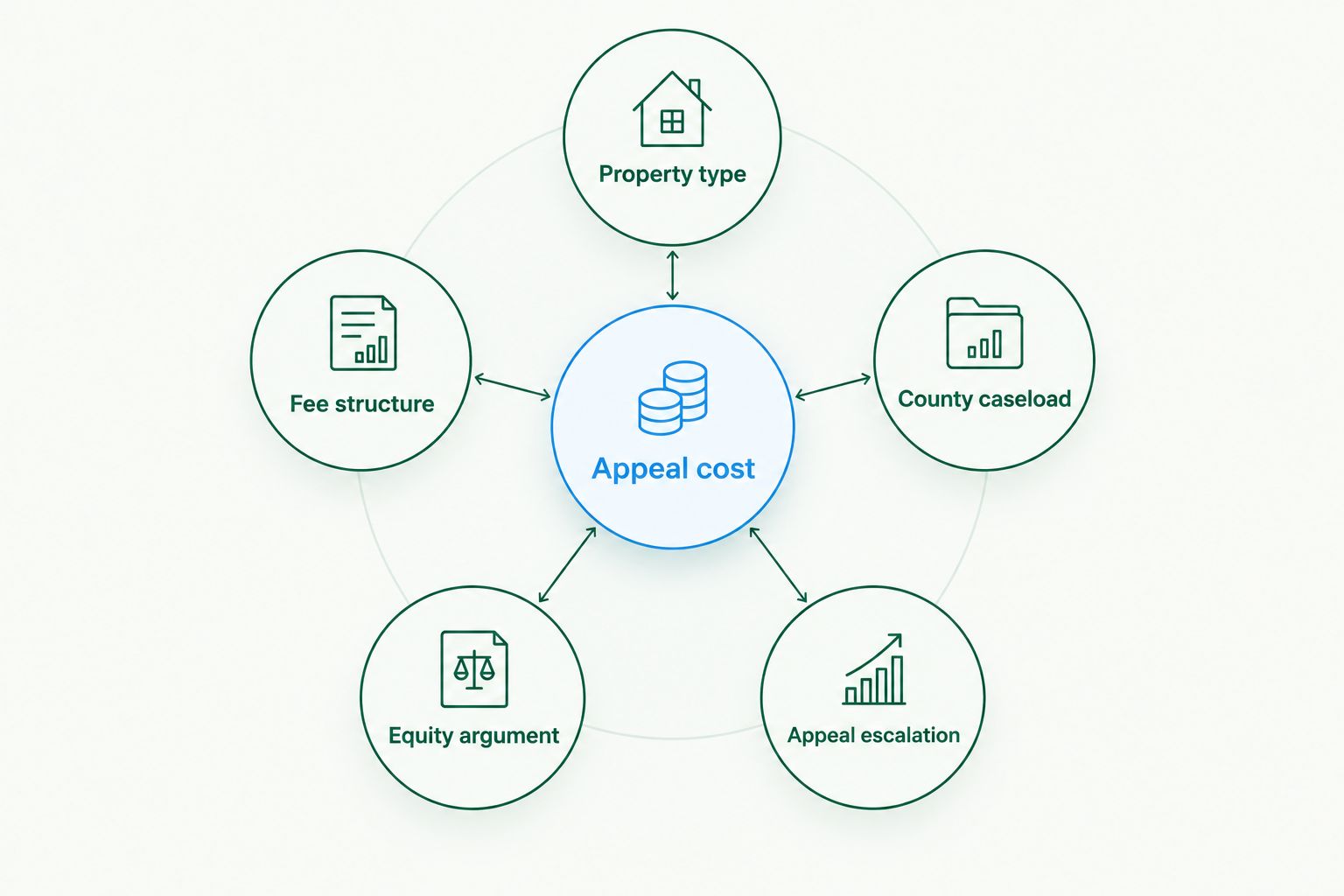
Fee structure and property type move the cost more than any other factor.
See your Georgia assessment for free
Free instant analysis, then a flat $129 fee only if you file.
Related questions
Is it worth appealing your property taxes in Georgia?
10-15% is the typical annual savings from a successful Georgia property tax appeal in 2026, which makes filing worth it for most owners whose assessment sits above market value. With 30-60% of properties carrying an inflated assessment and only about 5% of owners appealing, most people who'd benefit simply never file.
What's the deadline to appeal a property assessment in Georgia?
45 days is the standard window to appeal after your Annual Notice of Assessment arrives from the Board of Tax Assessors. Miss that window and you wait until next year's notice to try again, paying the higher bill in the meantime.
Do I need a lawyer to file a property tax appeal in Georgia?
No — you don't need a lawyer to appeal in Georgia. Homeowners can file directly with the Board of Tax Assessors and represent themselves at the hearing; attorneys and consultants come into play mainly for commercial or multi-family properties where the valuation dispute is more technical.
FAQ
How much does it cost to appeal property taxes in Georgia?
Appealing costs $0 if you file yourself with the Board of Tax Assessors, or $129 per property, per tax year, with a flat-fee packet in 2026. Contingency attorneys skip the upfront cost but take a percentage of your savings instead.
Is there a fee to file an appeal with the Georgia Board of Tax Assessors?
No, Georgia does not charge a fee to file an appeal directly with the Board of Tax Assessors. That's different from New Jersey, which charges an upfront non-refundable filing fee.
How much does a flat-fee appeal packet cost in Georgia?
A flat-fee appeal packet costs $129 per property, per tax year, regardless of how large the reduction ends up being. A free instant analysis usually comes first so you know whether filing makes sense.
What's the deadline to appeal a Georgia property assessment?
45 days from the date on your Annual Notice of Assessment is the standard Georgia appeal deadline. The exact date is printed on the notice itself, so check it as soon as it arrives.
How much can I save by appealing my Georgia property taxes?
10-15% is the typical annual savings from a successful Georgia property tax appeal in 2026. Savings depend on how far your assessment sits above market value or your assessment class's ratio.
Do I need a lawyer for a Georgia property tax appeal?
No, a lawyer isn't required for a Georgia property tax appeal. Owners can file and represent themselves at the Board of Tax Assessors hearing; attorneys are more common for commercial or multi-family disputes.
What is the unequal appraisal argument in Georgia?
Georgia's unequal appraisal argument lets you compare your property's assessment ratio to similar properties in your class instead of relying only on market value. It's a statute shared with Texas that most other states don't offer appellants.
Can landlords with multiple Georgia properties use a flat-fee appeal service?
Yes, landlords can use a flat-fee appeal packet on each property separately, paying the flat rate per property per tax year. That keeps cost predictable across a portfolio instead of scaling with total savings.
One last thing
Georgia is one of only two states, alongside Texas, that lets you argue unequal appraisal instead of just market value — and most owners who appeal never use it because they don't know the option exists. If your neighborhood's assessment ratios are inconsistent, that argument can matter more than any comp you pull.
Related guides
Paying Too Much in Property Taxes?
Let our licensed property tax experts assess your tax bill for potential savings. Over 80% of protests get a reduction of more than $1,000 and it takes less than 3 minutes to enroll.
⏰
🏠
💵
No Savings No Fee